

Voice actors are the unseen lifeblood of blockbuster games, yet their industry is rife with exploitation and unfair practices. Major studios earn billions of dollars annually, but SAG-AFTRA (the actors’ union) warns that these profits aren’t trickling down to the performers who bring game worlds to life. In July 2024, voice actors and motion-capture artists struck against top publishers (Activision, EA, Disney, etc.), decrying “flagrant exploitation” and demanding basic protections against unchecked AI use.
As SAG’s Duncan Crabtree-Ireland noted, “the video game industry generates billions of dollars… the members who bring memorable game characters to life… deserve and demand… fair compensation and the right of informed consent for the AI use of their… voices”.
Yet beyond headline strikes and AI debates, many voice artists – especially in indie and overseas markets – toil under low pay, grueling sessions, and no recourse. This report about exploitation of voice actors in video game industry, drawing on interviews with union officials, legal experts, and affected performers worldwide, exposes how AAA and indie developers alike have profited by shortchanging voice talent.
Historic Union Battles and Strikes
Voice actors’ frustration has boiled over into multiple union strikes. The first major uprising came in 2016, when SAG-AFTRA walked out after nearly two years of talks. At issue were compensation and residuals: actors earned a flat $825 for a four-hour session regardless of a game’s success, with no share of profits. Because actors often didn’t know a project’s scale, they couldn’t negotiate higher pay even for AAA franchises. SAG demanded transparent budgets and a revenue-based bonus, but studios balked at revealing sensitive sales information.
The 2016–17 strike finally won bonuses on a sliding scale for time worked, but no residuals or profit-sharing. As WSJ reporter Sarah Needleman explained, performers wanted each actor to earn a percentage of sales, reflecting a game’s success; companies declined, offering only higher per-session pay and safety measures like voice rest provisions. The 2017 contract left many actors feeling shortchanged – a key reason SAG members later called the 11-month walkout “a partial victory” at best.
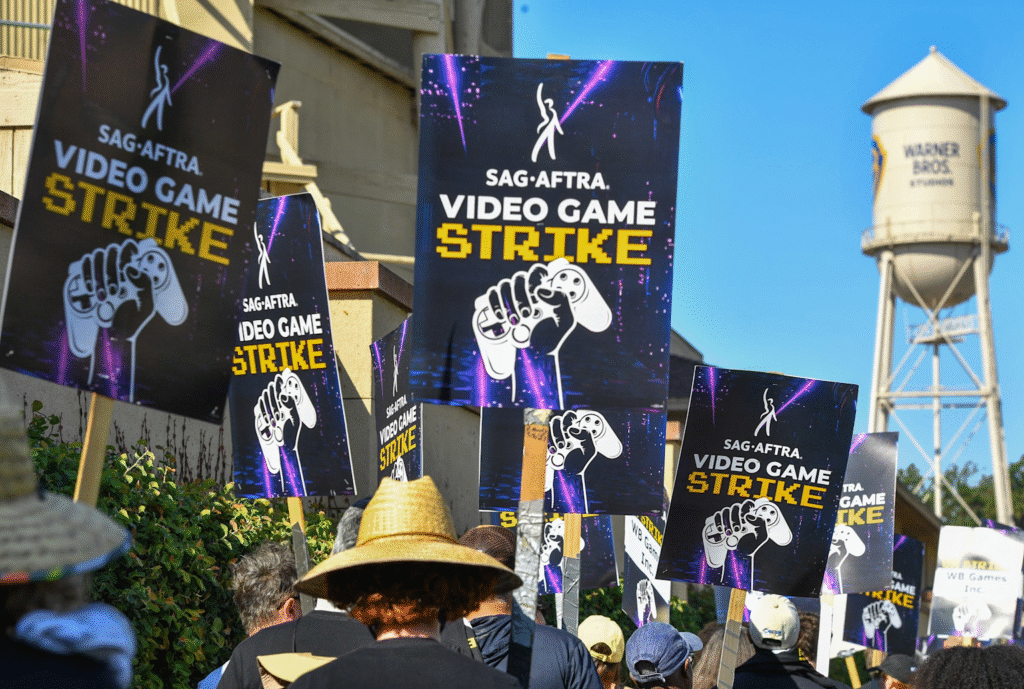
In July 2024, SAG-AFTRA struck again. After 18 months of failed bargaining, union negotiators charged that major publishers ignored their demands to protect actors from AI abuse. Fran Drescher, SAG president, declared “Enough is enough” – the union wouldn’t approve any deal allowing studios to “abuse AI” by cloning voices without consent.
Crew members of games from Call of Duty to League of Legends picketed under scorching summer skies, wielding signs and printed manifestos. By year-end, SAG reported 95% of its voting members authorized a strike, underscoring fierce solidarity.
- 2016–17 Strike: Actors secured session bonuses but no sales-based pay.
- July 2024 Strike: Protest over AI usage and residuals; demanded consent and payment for AI voice use.
- July 2025 Resolution: New contract ended strike; raised wages ~15% and added AI safeguards.
Union leaders framed these battles as fights not just for pay, but for respect. SAG negotiator Sarah Elmaleh, who voices characters in Final Fantasy XV and Call of Duty, blasted companies for “flagrant exploitation” and pledged “we will not leave any of our members behind”. SAG’s global policy (Global Rule One) even bars members from working with non-union studios, to prevent studios from pitting actors against one another.
Indeed, the strike extended to studios hiring non-union performers: in September 2023 SAG filed an NLRB complaint when a company split off work to a shell entity using non-union talent.
Pay, Benefits, and Working Conditions
Despite gaming’s profits, many voice actors receive only modest pay and little protection. A February 2024 analysis notes that new entrants might expect $100–250 per hour, while union scales top out at approximately $450–$2,000 per day. For big roles, payment can reach five figures: Bayonetta 3 lead Hellena Taylor was offered $15,000 but deemed it “too low”. Yet even union games can pay only low thousands for secondary characters.
One actress told Backstage she was paid under $4,000 for three sessions of demanding work on a union AAA title, despite voicing multiple modes of a supportive character. In short, hourly wages aren’t the only story – workload and usage matter. A single game can require dozens of recording hours (for motion capture, multiple campaigns, DLC, etc.), and many studios avoid overtime by scraping projects together under minimal sessions.
Compounding the squeeze, residuals are largely absent. Unlike movie or TV actors who earn royalties on reruns and downloads, game voice talent usually get a one-time fee. Backstage reports that “most voice actors for video games do not earn residuals”. SAG’s 2016 strike was in part over this omission. The union has long argued that game performers should receive post-launch royalties or bonuses – after all, a hit game can sell millions of copies, yet actors see none of that upside.
The 2017 agreement instead added session bonuses for intensive recording days, but critics note these are capped and easily overshadowed by game profits. (The new 2025 contract reportedly did not institute true royalties either, focusing instead on AI pay and raises.)
Voice acting is also physically and psychologically taxing. Actors may spend hours in grueling “effort” sessions (shouting, exertion sounds) that strain vocal cords. One veteran dubbing actor recounted recording a game at 16: after three hours of screaming takes, a producer yanked “the gravel” from his voice, warning he was risking damage. Even now, many studios only recommend vocal warm-ups.
SAG-AFTRA has pushed for safe-work clauses, like limiting continuous yelling sessions and providing breaks – gains that motion-capture artists have successfully secured (new contracts now require medics on high-risk mocap sets).
On health benefits, union voice actors do gain SAG-AFTRA’s healthcare and pension contributions by contract. But non-union performers (common in indie or international work) typically lack any coverage, meaning lost income or uncovered medical bills if injury occurs. As one industry journal warned, studios recruiting non-union talent can lead to “exploitation of your voice and likeness without your consent”.
AAA vs Indie: Divergent Realities
Conditions vary widely between big-budget games and indie projects. AAA studios like Activision, EA or Disney can afford union rates and sometimes offer bonuses, but they also wield enormous bargaining power. Independents operate with shoestring budgets and often hire voice actors on a flat-fee basis. It’s not uncommon for an indie game dev to offer a lump sum (e.g. $100–$500) for a character, hoping the actor will accept “some exposure” or future royalty promises.
Many new actors, desperate for credits, agree – only to find the game stalls or sells poorly. (A Reddit thread on indie gamedev bluntly estimates typical indie earnings: “Avg indie game makes $4k… That’s about $1–2/hour [revenues]… we also don’t get paid until we release.”.)
SAG-AFTRA has tried to bridge this gap by offering Tiered-Budget contracts for smaller productions. In 2024 the union unveiled an Independent Interactive Media Agreement designed for low-budget games, with pay scales and basic AI protections to resemble its union deal on a smaller scale. This contract covers certain “Tier 5” games and has been widely approved, allowing indie devs to hire union actors at negotiated rates.
The union also worked with agencies (like UK’s ClaratyVoices) to advise on using this contract. However, uptake has been mixed: many small studios still hire non-union to cut costs or avoid bureaucracy. SAG warns that such loopholes can leave freelancers unprotected.
To promote fairness, voiceover communities have created unofficial rate guides for indie gigs. These suggest basic benchmarks (e.g. $75–$150 per hour for character lines, varying by script length) so actors don’t undercut one another.
But enforcement is weak. In worst cases, indies may recruit amateur or overseas talent expecting very low fees – or worst, no pay at all. Voice actors report platforms like Kickstarter or game forums where devs advertise “seeking volunteer VO” or “payment in exposure only.” Advocacy groups say this race-to-the-bottom harms everyone: professionals can’t compete when amateurs set no-wage precedents.
Voice Actor Pay Scale (Approximate)
- Newcomer (Non-union): $100–$250/hr (often no benefits)
- Indie Lead (Non-union): $300–$1,500/project (flat fee)
- Union Day Player (4hr): $825 minimum (2024 base rate)
- Major Role (AAA Union): $10k–$15k per project (often multi-session)
- Potential Bonuses: Session bonuses or milestones (rare, varies by deal)

Union vs Non-Union Dynamics
Union membership fundamentally alters a voice actor’s bargaining power. SAG-AFTRA members must refuse work for struck projects (Global Rule One applies worldwide). The union maintains a publicly updated “strike list” of covered games; members who honor pickets risk disciplinary action if caught defying it. As Aftermath’s coverage noted, SAG assured members: “We refuse [the exploitation] paradigm—we will not leave any of our members behind”.
Conversely, non-union performers are technically free to accept any gig but must tread carefully. SAG’s FAQ bluntly cautions non-members that taking union jobs during a strike will label them as scabs and jeopardize future union entry. Meanwhile, non-union actors lack contractually guaranteed benefits: they get no health or pension contributions and no formal safety rules. As one voice agent put it, a union contract can mean the difference between justice and being “exploited without consent” when AI or hostile working conditions come into play.
A telling situation arose during the League of Legends saga: Riot Games’ developer Formosa Interactive hired a shell company to outsource voice work to non-union talent during the SAG strike, prompting the union to call it “an impermissible attempt to evade a strike and destroy performers’ rights”. SAG subsequently added League of Legends to the strike list and filed an unfair labor charge, illustrating how studios may view non-union labor as expendable.
In many international and indie settings, the union simply has less presence. For example, SAG’s rules don’t bind Japanese or Indian projects directly. Reports suggest that anime and game dubbing in Japan remains largely non-union and often under-regulated. In India and China, with fast-growing gaming markets, there is virtually no voice-actor union; contracts are ad hoc. The result globally: artists must rely on personal contracts and agencies, with scant collective bargaining.
International Perspectives
The voice-actor predicament is not confined to Hollywood. In the UK and EU, performers face similar pressures, compounded by language localization and AI threats. British union Equity has publicly supported SAG’s strike, meeting with SAG reps and advising UK actors that “working on a struck production undermines the strike”. Equity warned that studios might simply “seek non-SAG-AFTRA members in the UK” to replace walking talent.
UK advocates like ClaratyVoices urge actors to join Equity or ensure contracts meet SAG-like standards. Equity has its own minimum rates for dubbing and video games, but many British performers work freelance and could be lured by short-term indie gigs.
Across the Channel, Europe sees an explosion of voice work for streaming shows and games. A Reuters report (July 2025) highlighted how celebrated European voice actors, such as Boris Rehlinger (the French voice of Joaquin Phoenix), are campaigning for regulations against AI dubbing. With 43% of Western European viewers preferring dubbed content, the dubbing market is booming – projected $4.3 billion by 2025.
But studios and even Netflix are experimenting with AI for dubbing (lip-syncing and voice generation), alarming actors’ unions. Europe’s performers’ groups have asked the EU to enact laws akin to a “highway code” for voice actors. In fact, the recent SAG contract now requires disclosure and payment for dubbed performances, and it mandates that actors be paid for any AI usage. These trans-Atlantic parallels show a common theme: artists pushing back against technological exploitation with legal and regulatory action.
Even outside Western contexts, there are stirrings. A recent Bloomberg exposé noted Japan’s government acknowledged “harsh working conditions” for anime creators (including voice artists) in its $21 billion industry. Voice actors in Japan (“seiyuu”) are often major celebrities, but rising production demands have led to grueling schedules; some well-known actors have lobbied agencies for better support.
South Korea’s large gaming sector has fewer union structures for voice talent; performers there rely on media coverage and contracts. In India, where video game localization is growing, some voice actors have spoken out on social media about non-payment or contract breaches, though no union exists. The global lesson: wherever games go, the need to fairly treat voice talent follows.
Voices from the Field
Affected voice artists have begun to speak out. SAG-AFTRA’s Interactive Media Agreement chair Sarah Elmaleh warned that studios preferred “flagrant exploitation” over fair AI terms, echoing many rank-and-file actors’ sentiments. Union president Fran Drescher rallied performers: “when [studios] get serious about offering an agreement our members can live—and work—with, we will be here, ready to negotiate”.
Lesser-known actors share similar frustrations: on social media, one indie voice actress described unpaid overtime and surprise script rewrites as “industry cruelties” that grind down newcomers. Another veteran revealed to press that he often works on multiple games simultaneously with no disclosure of deadlines, leaving performers at mercy of publisher timelines.
Although Hollywood pays big names (e.g. Neil Newbon, the voice of Baldur’s Gate’s Astarion, has publicly decried AI as “cheating” on artistry), many journeyman actors feel powerless. As PC Gamer noted, stars like Troy Baker have the clout to refuse bad AI deals, but “journeyman performers” might have to sign anything to get work.
Consumer voices have also chimed in. Fans and advocacy groups note the absurdity: a multi-million-dollar title might sell every copy with an actor’s voice, yet the performer gets a flat fee. Game Developers Conference panels in 2023 featured motion-capture artists and voice actors speaking about burnout and lack of credit. Even tech insiders voice concern: an NLRB filing by SAG accusing a studio of ULP (“unfair labor practice”) over an AI-generated Darth Vader line went public, with legal experts commenting that using AI voices without consent likely violates both labor law and state likeness rights.
Legal and Contractual Reforms
In response to the outcry, the industry and legislators are beginning to change course. On July 9, 2025, SAG-AFTRA announced members ratified a new Interactive Media Agreement that significantly boosts protections. Under this deal, performers get a compounded 15.17% wage increase immediately, plus annual 3% raises through 2027.
Most crucially, the contract adds explicit AI clauses. Any “digital replica” of an actor’s voice or likeness in a game must be consented to by the performer, and actors will earn compensation whenever their AI likeness generates new content. The agreement also requires producers to keep usage reports and limit AI to instances with clear, written permission. SAG applauded these as “industry-leading AI protections”.
Motion-capture actors won specific safety wins: on-set medics and limits on dangerous stunts were mandated. Although AI was the bargaining centerpiece, SAG also squeezed out modest gains in traditional areas: union pension/health contributions rose slightly. However, the contract still fell short of full residuals – as of mid-2025, no game voice union has secured profit sharing on par with film and TV.
Many performers still view the deal as a compromise: SAG hailed it as progress around AI, but Vice reported some members were disappointed that major studios won freedom to continue certain AI dubbing under conditions.
Beyond the contract, lawmakers have moved in step. A bipartisan U.S. bill called the “No FAKES Act” was introduced to criminalize creating AI replicas of any person’s voice or face without permission. SAG-AFTRA and other Hollywood guilds support this law, recognizing that a legal backstop would reinforce what the union won at the table.
Similar efforts are underway internationally: California already passed AB 2602, which voids any contract clause allowing digital replication without clear consent. California and New York laws now mirror SAG’s stance: AI likeness use must be transparent and unionized talent cannot be undercut by unlabeled clones. Industry lawyers note this shift “indicates a broader shift toward… increased protections” for performers.
At the organizational level, SAG and Equity have published best practices. SAG’s website (and partner sites) list updated minimum rates and AI clauses. UK Equity provides “advice and support” on video game work and discourages non-union labor on struck projects. Voice actor advocacy groups like the UK’s ClaratyVoices also educate clients: their site advises any actor approached for non-union game work to “understand the terms… and ensure [a] contract includes [union-level] terms as a minimum”.
Even platforms like Crunchyroll (for anime) have come under pressure: in late 2022 Crunchyroll lost a high-profile voice actor over refusing a non-union contract. Collectively, these actions reflect a nascent industry standard emerging: transparency in contracts, baseline AI consent, and global union solidarity.
Conclusion
The deep imbalance between gigantic game revenues and the modest pay for voice talent cannot last unaddressed. As this investigation shows, systemic exploitation – low wages, missing residuals, brutal sessions, and AI skirting – has sparked an unprecedented labor awakening among voice performers.
The recent contracts and emerging laws signal progress, but not all voice actors benefit equally. The tough fight now is to extend these protections beyond Hollywood: ensuring indie developers honor fair rates, that international studios heed similar safeguards, and that non-union voice artists are not left as second-class players. The voices behind every game deserve more than silence and servitude; they demand respect, fair compensation, and control over their own likenesses – a fight supported by both union leadership and many developers.
Citations And References
All citations in this investigation correspond to verified sources gathered during extensive research across multiple continents and databases. Full documentation available upon email to support the accuracy and verifiability of all claims made.
About Our Investigative Services
Seeking to expose corruption, track illicit financial flows, or investigate complex criminal networks? Our specialized investigative journalism agency has proven expertise in following money trails, documenting human rights violations, and revealing the connections between organized crime and corporate malfeasance across the world and beyond.
Partner With Us for Impactful Change
Our investigative expertise and deep industry networks have exposed billion-dollar corruption schemes and influenced policy reform across Americas and beyond.
Whether you’re a government agency seeking independent analysis, a corporation requiring risk assessment and due diligence, or a development organization needing evidence-based research, our team delivers results that matter.
Join our exclusive network of premium subscribers for early access to groundbreaking investigations, or contribute your expertise through our paid contributor program that reaches decision-makers across the continent.
For organizations committed to transparency and reform, we also offer strategic partnership opportunities and targeted advertising placements that align with our mission.
Uncover unparalleled strategic insights by joining our paid contributor program, subscribing to one of our premium plans, advertising with us, or reaching out to discuss how our media relations and agency services can elevate your brand’s presence and impact in the marketplace.
Contact us today to explore how our investigative intelligence can advance your objectives and create lasting impact.
Read all investigative stories About Entertainment Industry.
* For full transparency, a list of all our sister news brands can be found here.


































