

Experts warn that modern electric vehicles (EVs) are “crawling with computers, various radios, Lidar sensors and external cameras” and in short, rife with data that could be of interest to spies. A British security consultant notes that an EV’s abundant connectivity (over-the-air updates, embedded telematics, even smartphones paired via USB) creates “lots of opportunities to collect data and therefore lots of opportunities to compromise a vehicle”. One of our analysts warns that, “Corporate Espionage in the Automotive Sector, is real.”
In practice, this means every Tesla, BYD or BMW on the road may be leaking streams of location, user and sensor data. For governments and corporations, the fear is not just theft of blueprints but real-time surveillance: as one specialist warns, an EV’s microphones, cameras and phone-connectivity could turn it into a surveillance platform.
The stakes are highest in the booming EV and autonomous-vehicle (AV) market. Tesla’s Autopilot and similar driver-assistance systems rely on artificial intelligence trained by vast driving data, making them prime targets for copyists.
In one high-profile case, Tesla sued a former engineer who allegedly copied proprietary Autopilot code before joining a Chinese EV startup. Tesla’s own filings describe a scheme in which the engineer “copied the source code of the EV maker’s Autopilot technology” and took it to Xpeng Motors (via its US arm XMotors). The lawsuit, settled in 2021, underscores how the most valuable assets in the auto industry are no longer steel or machines but software and datar.

Early warnings have come from the very top. In March 2024 President Biden announced an investigation into whether Chinese-built EVs could be Trojan horses for spying, citing “new avenues for espionage and sabotage” created by connected cars. His move was as much political as security-driven: analysts note it signals toughness on China during an election year.
Scott Kennedy of the CSIS think tank observed that the probe “seems as much oriented at blunting accusations of being weak against China” as solving any proven threat. Nevertheless, automakers from Detroit to Stuttgart are not waiting for proof. The European Union and U.S. have proposed tariffs and security reviews on Chinese EVs, while German carmakers lobby Beijing to tighten its own data rules.
As one U.S. senator bluntly put it: “There’s no place in the U.S. for vehicles made by Chinese Communist Party–backed companies”. Beijing, for its part, has accused the U.S. of hype. A Chinese embassy spokesman warned that U.S. leaders are “hyping up the ‘China threat’ theory” to stifle competition.
A Global Market, a Global Battlefield & Major Examples of Corporate Espionage in The Automotive Sector
Automakers and suppliers worldwide report a spike in attempted data breaches, spies and legal battles. In the United States, a string of lawsuits and indictments have punctuated the headlines. Besides Tesla’s case, start-up Canoo accused ex-employees of orchestrating a wholesale theft of its EV platform. A December 2022 lawsuit charged that a rival startup (Harbinger Motors) used ex-Canoo executives to “infiltrate Canoo and steal its intellectual property,” poaching dozens of its engineers in the process.
Canoo characterized it bluntly as “a case of corporate espionage by a group of serial grifters”. Although that suit was filed in California federal court, similar stories abound: virtually every major automaker now invests heavily in monitoring its own network and personnel for leaks.
In Europe, historic scandals have made the threat clear. In 2011 Renault stunned observers when it suspended three senior executives in a sting operation over EV battery secrets. French authorities feared the leaked information on battery costs and models could have been sold to a foreign power.
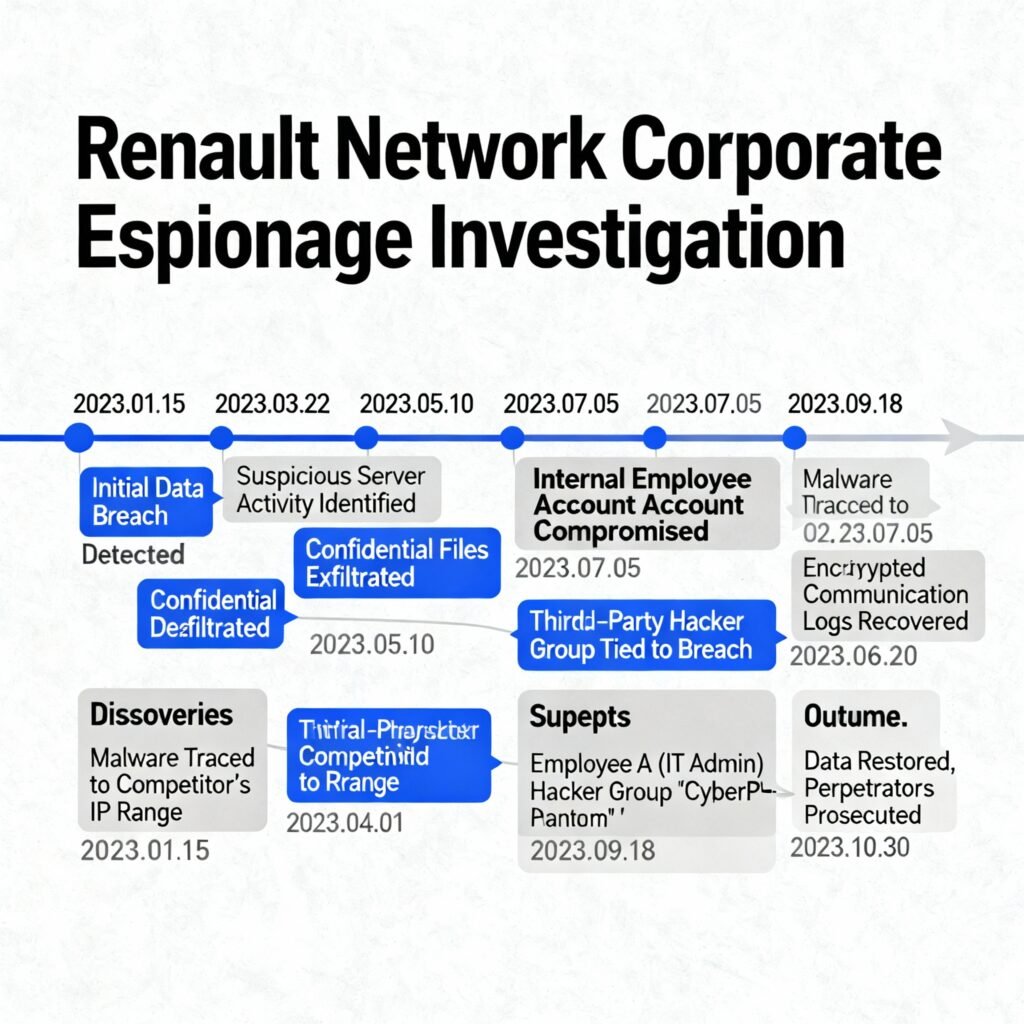
The resulting investigation, code-named “Renault Network,” even drew in French intelligence services and caused a diplomatic chill with China. Media reports at the time said the data targeted multi-million-euro battery technology not even patented yet. Publicly, Renault later admitted that while “sensitive data” on costs was stolen, core patents were safe – but suspicion lingered that a competitor had penetrated the R&D ranks.
Across the Channel, the UK’s Jaguar Land Rover (JLR) became the target of a major cyberattack in 2025, forcing all its UK factories to shut down for weeks. Although this incident appears criminal rather than state-sponsored, it illustrates how vulnerable modern automaking is. JLR lost roughly £50 million per week during the outage, and the British government intervened directly.
As one JLR executive told ministers: the priority was to get supply chains running again and jobs saved. JLR’s ordeal was one of many: in the same period, ransomware attacks knocked out an airport check-in system and hacking groups boasted of hitting high-profile targets. Industry insiders warn these cyberattacks are often precursors to espionage: infiltrating a supplier or plant for extortion can also deliver terabytes of proprietary data.
Robots on the Line. Modern factories rely on automated assembly, but even these plants have not been safe. High-tech robots assembling cars (above) can be hacked, just like office PCs. Companies now routinely encrypt designs and log all remote connections, but insider threats persist. Many espionage cases involve disgruntled or bribed employees.
For instance, a Michigan federal jury recently awarded $2 million against a contracting firm that hired away an engineer under false pretenses and then claimed his IP as their own. Similarly, autonomous-driving pioneer Waymo(Google’s self-driving unit) sued Uber in 2017 for allegedly stealing LiDAR designs, settling the case for $245 million. This was far from automotive theft in the classic sense. It was Silicon Valley pilfering but it underscores that as cars turn into robots, their software is a prime espionage target.
Methods of Espionage: Cyber and Physical
The techniques range from cold hacking to warm-blooded betrayal. Cyberattacks have hit cars at the factory and beyond. In 2023-25, multiple auto suppliers, dealerships and carmakers reported data breaches, often by sophisticated ransomware gangs. In one example, UK car dealer Vertu Motors warned of a £5.5m profit hit after a January 2025 data breach that disrupted the supply chain for Jaguar Land Rover.
In Asia, security reports show Chinese state-backed hackers have targeted auto manufacturers for years, often using spear-phishing and malware to exfiltrate CAD files and software. Conversely, U.S. intelligence agencies have increasingly singled out Chinese tech firms as potential backdoors. A U.S. Pentagon-funded study on connected vehicles warned that any networked car made in China could theoretically be compelled to “support, assist and cooperate” with state espionage under Chinese law.
No public proof has emerged of such misuse, but the concern is acute: one cyber expert said bluntly that if any car “is capable of spying on you it may be misused to do so”.
Physical espionage remains equally potent. In France, spies even operated under cover: as Reuters later revealed, the Renault case was in part based on an anonymous tip and alleged bribery, hinting at an elaborate network. In another European sting, investigators found that an EU-funded auto research project was hit by a Russian espionage cell targeting electric-vehicle grants.
Industry recall saw cases where secret blueprints for engines or batteries were found on personal USB drives of engineers who took jobs at foreign companies. In the United States, a 2018 incident involved a Chinese national who worked as an intern at a supplier and tried to smuggle out technology documents; he was later convicted of economic espionage.
Experts note these are not isolated: as the French economic spy school puts it, “there are players with completely different behaviour” in global markets now. The vast sums behind EV and AV R&D, often billions of dollars per model mean even a small leak is huge.
Voices from the Front Lines
Affected companies and insiders speak cautiously, often on background. A former senior Renault executive, speaking anonymously after the 2011 scandal, complained that the public presumption of guilt “left him puzzled,” since Renault announced only that it “knew what had happened” without details. He and his lawyer noted that the men were effectively fired without fair process.
In Detroit, one retired automaker R&D head worries that “even top managers now rarely see the details of tech secrets as everything is compartmentalized to prevent exactly these leaks.” Meanwhile, union representatives in the U.S. have lobbied Congress, warning that thousands of auto jobs depend on intellectual property remaining secure. UAW leaders in Michigan publicly backed Biden’s probe, stressing that losing battery or self-drive know-how overseas “would be catastrophic.”
Legal experts also contribute perspective. Alan Woodward, a University of Surrey security professor, notes that unlike consumer electronics, cars have exceptionally long development cycles: “The result is a big temptation to cheat to win the race when you are behind,” as one French lawmaker put it. Cyber law specialists emphasize new domestic regulations: for example, France passed a broad counter-espionage law in 2023, prompting concerns it might itself chill foreign investment.
In Germany, the powerful VDA auto association warned Berlin in 2023 that China’s new anti-spy laws lack corporate confidentiality and urged diplomatic pressure to protect German industry data. A U.S. tech lawyer notes that even when espionage is detected, prosecution is rare. “Trade-secret law enforcement is tricky,” he said. “You often end up with technical charges (like breach of contract), not proving who actually got the data.”
The China Factor and Global Comparisons
No country is immune. Chinese automakers themselves have accused Western rivals of sabotage. In 2011 Beijing pointed fingers at EU officials when European regulators demanded massive data on Chinese EV supply chains in an anti-dumping inquiry. China’s trade ministry slammed the EU probe as “unprecedented” in scope, and state media suggested Brussels was essentially spying on Chinese car firms.
Conversely, German manufacturers have long invested in China and today sell cars there by the millions – a fact that complicates the picture. German carmakers’ lobby VDA explicitly rejected decoupling, urging a balance between security and trade.
In China itself, auto espionage cases are often handled quietly. Western executives report pressures: a recent report says American defense contractors barred employees from pairing phones with some Chinese-built EVs, citing secretive data flows. Meanwhile Chinese EV firms (like BYD and NIO) have become globally competitive. BYD overtook Tesla in volume in 2023, and opened production plants abroad, raising new security questions.
Chinese media and officials counter that restrictions on their cars are protectionist. They note, for example, that BMW and Volkswagen have their own sprawling China partnerships and data sharing. Officially, China’s National Intelligence Law requires cooperation with intelligence agencies, and some Western analysts argue this creates unavoidable risk if Chinese-owned software/hardware is embedded in a car’s systems. Others caution that exploiting cars as spy platforms could sink China’s export ambitions if uncovered.
In other regions, patterns differ. In Japan and South Korea, corporate espionage historically centered on semiconductors and shipbuilding, but tech in Korean car firms is also a target. For instance, a former Samsung executive was arrested in 2023 for allegedly providing confidential green-car tech to Chinese rivals. India’s nascent EV market has reported attempted scams by investors seeking battery patents. Even smaller players, like startups in Israel or Silicon Valley, have fended off covert approaches for their AV algorithms. The United States and Europe now compare notes: U.S. law enforcement and the EU’s recently created anti-espionage network hold joint workshops on automotive IP theft.
Conclusion: Protecting the Fast Lane
The fallout from these incidents is still unfolding. Many targeted companies say little publicly, but behind closed doors boards are asking tough questions about cyber defenses, non-compete enforcement and screening of foreign partnerships. Some technology is becoming more open-source as a hedge against espionage, and governments are considering new restrictions on data exports. One thing is clear: as vehicles become computers on wheels, the line between corporate espionage and national security blurs. Automakers must now think like defense firms, guarding algorithms and code as fiercely as physical plants.
For car buyers and regulators alike, the issue has a personal angle too. Beyond secret designs, there is the privacy of drivers. Recent leaks of passenger video feeds (such as Tesla’s internal controversies) show how insider access can violate customer trust. Policymakers are examining EV cybersecurity standards and data-use disclosures, mindful that industrial secrecy must not come at the expense of public safety or privacy.
In short, the automotive race is as much about secrets and security as it is about speed and sustainability. As one European intelligence analyst put it of Renault’s case: “Everyone wants to develop a viable electric car” – which means “the level of penetration” by spies is no longer shocking. The industry now faces the hard truth that tomorrow’s breakout technology may only be safe behind the firewall of a well-guarded lab and the bright lights of prosecutorial scrutiny.
Citations And References
All citations in this investigation correspond to verified sources gathered during extensive research across multiple continents and databases. Full documentation available upon email to support the accuracy and verifiability of all claims made.
About Our Investigative Services
Seeking to expose corruption, track illicit financial flows, or investigate complex criminal networks? Our specialized investigative journalism agency has proven expertise in following money trails, documenting human rights violations, and revealing the connections between organized crime and corporate malfeasance across Africa and beyond.
Partner With Us for Impactful Change
Our investigative expertise and deep industry networks have exposed billion-dollar corruption schemes and influenced policy reform across Americas.
Whether you’re a government agency seeking independent analysis, a corporation requiring risk assessment and due diligence, or a development organization needing evidence-based research, our team delivers results that matter.
Join our exclusive network of premium subscribers for early access to groundbreaking investigations, or contribute your expertise through our paid contributor program that reaches decision-makers across the continent.
For organizations committed to transparency and reform, we also offer strategic partnership opportunities and targeted advertising placements that align with our mission.
Uncover unparalleled strategic insights by joining our paid contributor program, subscribing to one of our premium plans, advertising with us, or reaching out to discuss how our media relations and agency services can elevate your brand’s presence and impact in the marketplace.
Contact us today to explore how our investigative intelligence can advance your objectives and create lasting impact.
Read all investigative stories About Businesses And Industries.
* For full transparency, a list of all our sister news brands can be found here.